
Molarity Calculator
Preparing a solution? Type the chemical formula and the calculator works out its molar mass, then finds the molarity from a mass and volume, the mass you need to weigh out for a target concentration, or the volumes for a dilution. It reads parentheses and hydrates, shows the working, and handles units from mg to kg and µL to L.
- Free to use
- No sign-up
- Runs in your browser
Molarity calculator
Solution Prep Lab Pack
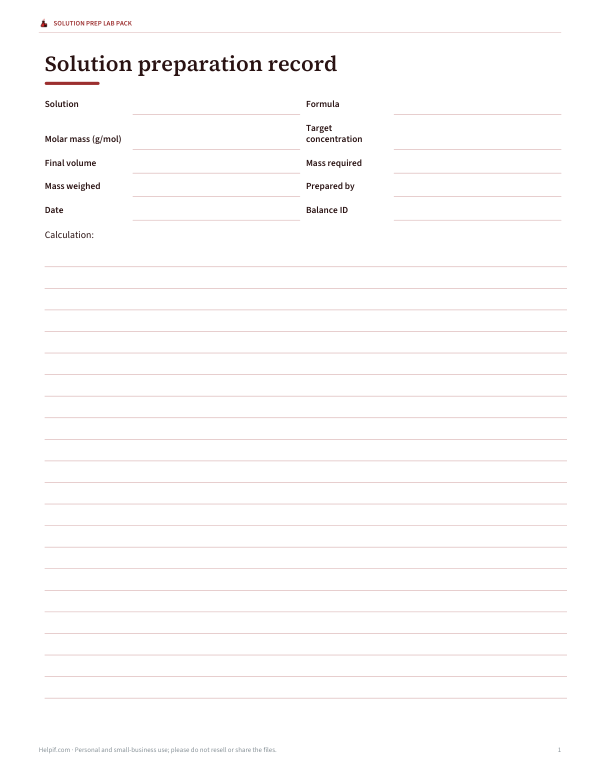
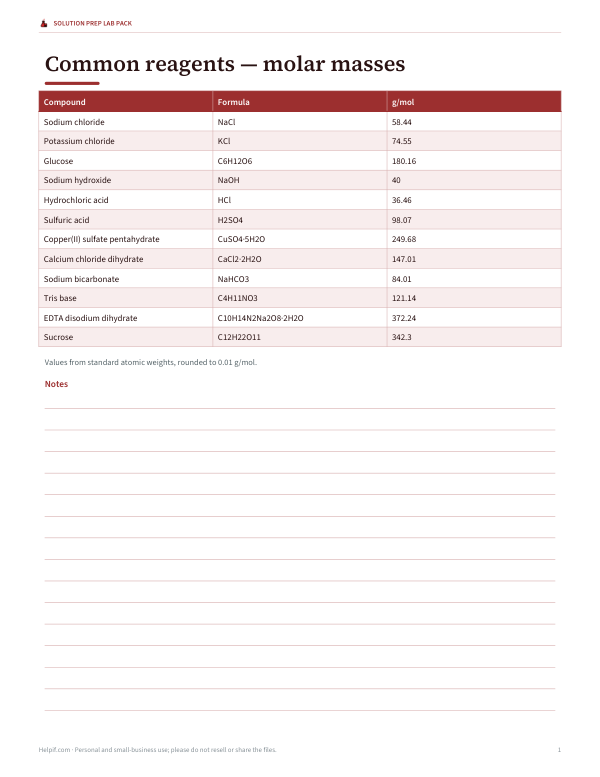
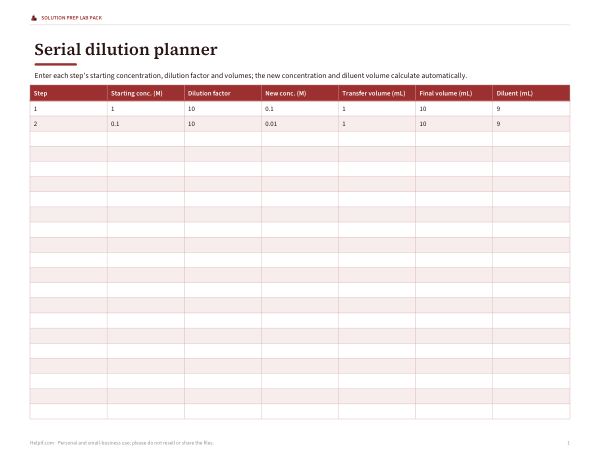
Printable lab aids: solution preparation worksheet, a common reagents molar mass table, dilution series planner (Excel), molarity practice problems with answers and a reagent label sheet.
- Prep worksheet (PDF/DOCX)
- Molar masses (PDF/XLSX)
- Dilution planner (XLSX)
- Practice problems (PDF, DOCX)
- Reagent labels (PDF)
Formats: PDF, DOCX, XLSX. Instant download after payment (link valid 72 hours, up to 5 downloads). AI-assisted: the templates were drafted with AI help and reviewed and laid out before publishing.
$3.00 USD, one-time 5 files · about $0.60 each
- Instant download
- 7-day refund
- Secure checkout by Stripe
7-day money-back guarantee. Full refund within 7 days of purchase, even after you download.
Free sample: Common Reagent Molar Masses (PDF, 49 KB)
Full refund within 7 days — see the refund policy and license.
Free printables
Single sheets you can print right now, no sign-up. The full pack adds every sheet in one download plus the editable files.
 Printable Molarity Practice Problems
 Printable Reagent Labels PDF
What molarity means
Molarity (M) is the number of moles of a solute dissolved in one litre of solution: M = moles ÷ litres. A 1 M sodium chloride solution contains one mole of NaCl — 58.44 g — in every litre of solution. Note that the volume is of the final solution, not the solvent added, so you dissolve the solute in less solvent and then make it up to the final volume in a volumetric flask.
Key formulas
| To find | Formula |
|---|---|
| Moles | n = mass ÷ molar mass |
| Molarity | M = n ÷ V (litres) |
| Mass needed | mass = M × V × molar mass |
| Dilution | C1 × V1 = C2 × V2 |
| Mass concentration | g/L = M × molar mass |
| Millimolar | 1 mM = 0.001 M |
How to make a solution of known molarity
- Calculate the mass needed: concentration × volume in litres × molar mass.
- Weigh the solute accurately on a balance.
- Dissolve it in about two-thirds of the final volume of solvent in a beaker.
- Transfer to a volumetric flask, rinsing the beaker into the flask.
- Make up to the mark with solvent, with the bottom of the meniscus on the line.
- Stopper and invert several times to mix; label with name, concentration, date and your initials.
Worked examples
- Mass needed: 250 mL of 0.5 M NaCl needs 0.5 × 0.250 × 58.44 = 7.305 g.
- Molarity: 7.305 g of NaCl in 250 mL gives 0.125 mol ÷ 0.250 L = 0.5 M.
- Dilution: to make 500 mL of 0.1 M from a 2 M stock, V1 = 0.1 × 500 ÷ 2 = 25 mL of stock, made up to 500 mL with water (a 20× dilution).
- Hydrates: copper(II) sulfate pentahydrate, CuSO4·5H2O, has a molar mass of about 249.7 g/mol — use this, not the anhydrous 159.6 g/mol, if weighing the blue crystals.
Entering formulas
| Input | Reads as |
|---|---|
| NaCl | sodium chloride |
| Ca(OH)2 | calcium hydroxide — brackets multiply |
| CuSO4·5H2O or CuSO4.5H2O | hydrate: adds 5 water molecules |
| C6H12O6 | glucose |
| K4[Fe(CN)6] | square brackets work too |
| (NH4)2SO4 | ammonium sulfate |
Element symbols are case-sensitive: Co is cobalt, CO is carbon monoxide. Atomic masses are standard atomic weights; for isotopically labelled compounds, enter the molar mass directly.
Molarity, molality and percent
Molarity uses litres of solution and changes slightly with temperature because liquids expand. Molality (mol per kg of solvent) doesn’t, which is why it is used in physical chemistry for freezing-point and boiling-point calculations. Percent concentrations are also common: % w/v is grams per 100 mL, so a 0.9% saline is 9 g/L — about 0.154 M NaCl.
Serial dilutions
A serial dilution repeats the same dilution several times to reach very low concentrations accurately — for example, four 1:10 steps take a 1 M stock to 0.1 mM. Each step uses C1V1 = C2V2 with the previous step as the stock. Transferring 1 mL into 9 mL of diluent gives a 10-fold dilution; 1 mL into 1 mL gives 2-fold. The downloadable planner lays out each step with its transfer and diluent volumes.
Accuracy tips in the lab
- Use a volumetric flask, not a beaker, to make up the final volume.
- Weigh by difference for hygroscopic solids, and work quickly.
- Check whether your reagent is anhydrous or a hydrate — the label formula matters.
- Allow solutions that warm up on dissolving to cool before making up to the mark.
- For very small masses, make a more concentrated stock and dilute it rather than weighing tiny amounts.
- Record lot numbers and calculations on the preparation sheet.
Converting between units
| From | To | How |
|---|---|---|
| M | mM | × 1,000 |
| mM | µM | × 1,000 |
| M | g/L | × molar mass |
| g/L | mg/mL | same number |
| % w/v | g/L | × 10 |
| ppm (dilute aqueous) | mg/L | approximately the same |
Worked example with a hydrate
To make 100 mL of 0.1 M copper(II) sulfate from the blue pentahydrate crystals, type CuSO4·5H2O: the molar mass is about 249.68 g/mol. Moles needed = 0.1 mol/L × 0.100 L = 0.010 mol, so weigh out 2.497 g of crystals. Using the anhydrous molar mass (159.60 g/mol) by mistake would give 1.596 g — a solution about 36% too weak. Dissolve the crystals, make up to 100 mL in a volumetric flask and mix well.
Safety
Always add concentrated acid to water, never water to acid, and wear eye protection when handling chemicals. Check safety data sheets for the substances you use. Dilution calculations assume volumes add ideally; for concentrated solutions, make up to the final volume rather than adding a calculated amount of solvent.
Privacy
The calculator runs in your browser; nothing is uploaded.
Frequently asked questions
How do I calculate molarity?
Divide moles of solute by litres of solution.
How many grams of NaCl for 1 L of 1 M solution?
58.44 g.
What is C1V1 = C2V2?
The dilution equation: stock concentration × stock volume = final concentration × final volume.
What is the difference between M and mM?
1 M = 1,000 mM.
Can it handle hydrates?
Yes, enter them like CuSO4·5H2O or CuSO4.5H2O.
Is molarity the same as molality?
No, molality uses kilograms of solvent instead of litres of solution.
Why do hydrates have a larger molar mass?
Because the water molecules in the crystal add to the mass you weigh.
What does 1 N (normality) mean?
Equivalents per litre; for an acid like H2SO4 with two acidic protons, 1 M = 2 N.
Is anything uploaded?
No, everything runs locally.